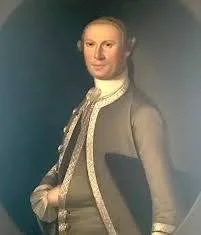
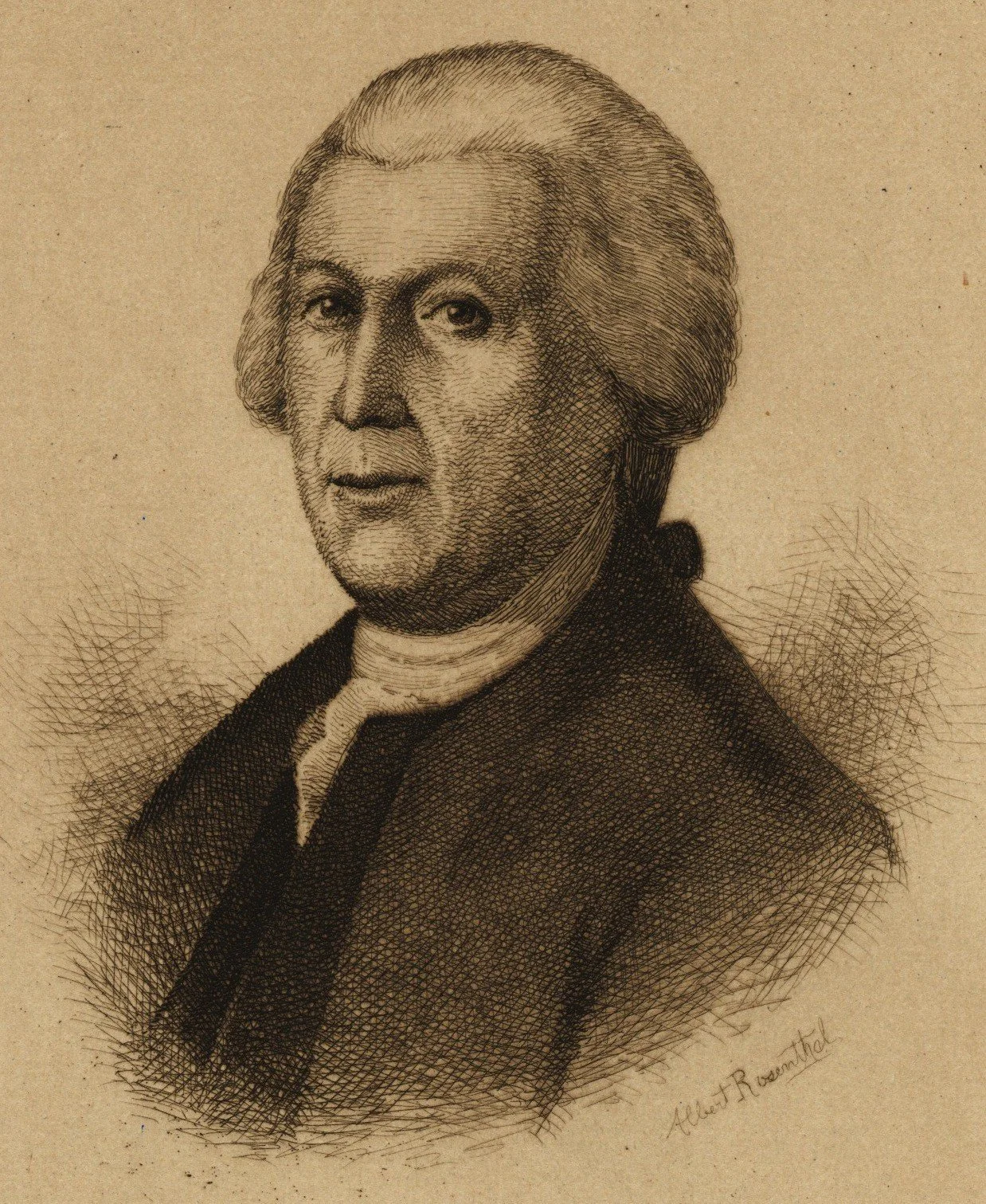
The chest tomb in the St. Anne’s graveyard memorializes the family of Dr. Charles Carroll (1619-1755), his second wife, Anne Plater Carroll, and his son, Charles Carroll the Barrister (shown above). Dr. Carroll came from Ireland and married Dorothy Blake in 1722, with whom he had four children, including Charles Carroll the Barrister. Around 1738, Dr. Carroll converted from Catholicism to Anglicanism in the hope that it would help his business interests, causing a rift in the Carroll family.
Charles Carroll the Barrister, who was born on March 22, 1722, was taken by his father to Europe for his education because, as a Catholic, education in the Anglican colony of Maryland was not available to him. After attending Eton College and the University of Cambridge in England, he returned home to manage the family’s properties at Carrollton. In 1755, he returned to London to study law before returning to Maryland. Although he never practiced law in Maryland, he began to call himself Charles Carroll the Barrister to distinguish himself from the other three Charles Carroll relatives after he returned to Maryland. Soon after his return, his father died, leaving him one of the wealthiest men in Maryland. Between father and son, the Carrolls had accumulated a great deal of wealth and property, which led Charles to help pay for Charles Wilson Peale to study painting in London. In 1760, he completed construction on his summer home at Georgia Plantation, naming it Mount Clare after his grandmother. In June 1763, he married Margaret Tilghman (1742-1817) from a wealthy Eastern Shore family, with whom he had no children who survived into adulthood. As an Anglican convert, he was elected to the St. Anne’s vestry in 1762
After his father’s death, Charles took his father’s seat in the Maryland Assembly until it was discontinued when the Revolutionary War began. At that time, he became involved with other patriots in the Annapolis Convention and joined the Committee of Correspondence in 1774. After voting to expel Royal Governor Sir Robert Eden, he hosted the Governor and his wife at Mount Clare until they sailed for England. He helped to frame the Maryland Declaration of Rights in 1776 and attended all nine of the state Constitutional Conventions. From 1777 until his death in 1783, he served as a Maryland State Senator.
Charles Carroll the Barrister died at Mount Clare on March 23, 1823, and was originally buried in the small graveyard at Old St. Paul’s Anglican Church in Baltimore, but later moved to the graveyard surrounding St. Anne’s Church in Annapolis. In 1917, Mount Clare Mansion became a museum operated by the National Society of the Colonial Dames in Maryland on behalf of the City of Baltimore.