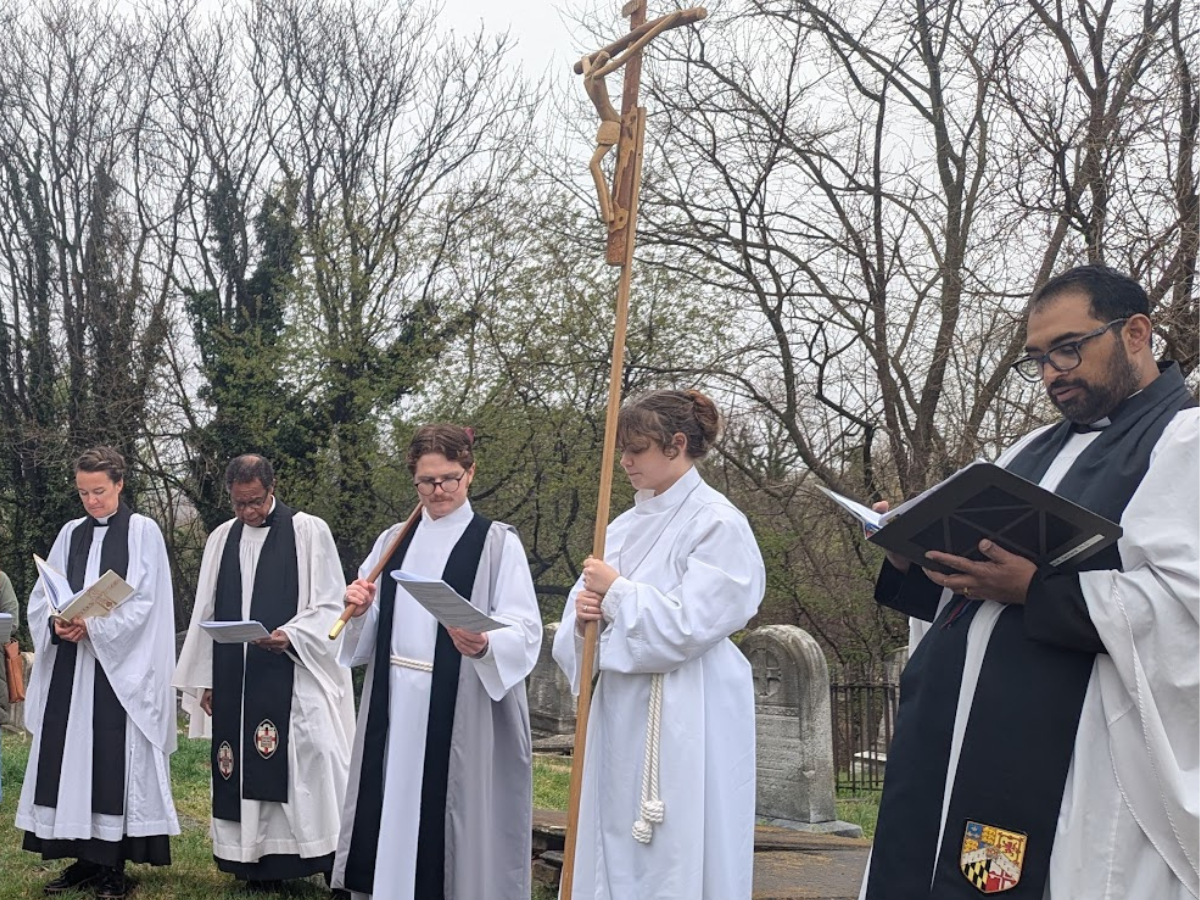
Caleb Briggs, Verger, and Magnolia Vandiver, Acolyte, with St. Anne’s Clergy at the Stations of the Cross Service on Good Friday
By: Martha Thorn
Do you have what it takes to be an acolyte?
Who are the acolytes? What do they do? Why do they do it? Why is it so important?
A lifelong member of St. Anne’s Episcopal Church, Katie Burke started asking those questions when she sang in the church’s Junior Choir. Looking down from the Choir Loft on Sundays, she would watch the acolytes filing into the church. They wore robes and carried crosses, banners, torches, and candles.
“They always seemed to be shrouded in mystery,” she says.
At the time, Katie was too involved in the Junior Choir to pursue the answers to her questions. Now on St. Anne’s vestry, she knows acolytes are volunteers, and she sees the program as an opportunity for people – both young and old – to become involved in the church. She’s even filled in as an acolyte herself when one was needed.
Ages now range from 8 to some seniors in their 70s and 80s. With this age range, this group represents one of the most intergenerational ministries at St. Anne’s. Each year, the group looks different as students graduate and relocate to further their education or to start their careers.
Almost anyone can be an acolyte. Almost anyone can volunteer. Acolytes have to be strong enough to hold and carry things and steady enough to go up and down the steps to the chancel without falling. Other useful characteristics are being responsible, on time, willing to learn, and patient.
More acolytes are always needed because there’s always something to be done. Ask the acolytes what they do, and they’ll say, “A little bit of everything.” Training is mostly on the job. It’s also on different levels, starting off with easy tasks for the novice and building up to more difficult ones, with becoming a verger being the top level.
Caroline Purdy, Caleb Briggs, Magnolia Vandiver, and Annie Devadason have all achieved that top level. They do what’s expected of them as vergers -- lead the processional and help with the organization and flow of religious services. And then, they do a little more. Most acolytes also volunteer as prayer leaders, chalice bearers, and readers. Some, like Annie, also serve on the Altar Guild (she’s been doing this for 12 years) and as eucharistic visitors.
Caroline and Annie have worked closely with the students and graduates from St. John’s College. “They represent an expansion of St. Anne’s family,” Caroline says.
They worked particularly closely with Caleb and Magnolia, two 2025 St. John’s College graduates who bid farewell to St. Anne’s parishioners in May 2026, and Nathaniel “Nate” Watkins, a rising senior at St. John’s College.
In addition to serving first as an acolyte and then as a verger, Caleb spent four years as a member of St. Anne’s Communications staff and one year as an office assistant. He has fond memories of all his work at St. Anne’s, but particularly of being an acolyte.
“St. Anne’s is a big community,” Caleb notes. “The acolytes are a community within a community. We’re a team in the sense that we work together and collaborate with clearly defined roles. We trust each other to get what needs to be done done.
“We know the other person has our back. If someone needs a reminder, it just takes a tap on the shoulder, a raised eyebrow, or a gesture. We read each other, trust each other, and need each other. It’s very fulfilling to be a part of such a team.”
Magnolia was an acolyte for four of the five years she attended St. Anne’s. “When I first volunteered, it was to meet people and move on to bigger things,” she laughs. “But it quickly became more. Now it’s first and foremost to help people worship.”
Before leaving St. Anne’s, she became the “Grand Master Acolyte” in charge of scheduling about 20 acolytes. Usually, four to six acolytes are needed for the 10 a.m. service and one or two for the 8 a.m. and 5:30 p.m. services. Most acolytes serve once a month, but some may serve at all three services for multiple times a month. Magnolia scheduled everyone based on the church’s needs and individual availability.
Nate has completed three of the four tiers of acolyte training and will begin training to become a verger in the fall. Nate compares being an acolyte to being a “brick in a wall.” It’s a small, but essential part of the overall spiritual experience.
Annie’s three boys were all acolytes. “I watched how it was done to prepare them,” she says. “Later, when I was asked to help as an acolyte, I wanted to do it. I have been doing it since the COVID restrictions were lifted." One of her sons, Lawrence, still lives locally and is the point of contact for one of St. Anne’s fellowship ministries called Suburb Theology.
Annie plans to continue to volunteer as an acolyte. “As long as I can walk, my mind is sound, and as long as there is a need, I plan to continue being an acolyte,” she says. “My regular schedule is once a month, but if I’m needed, I can do it in between.
“I came to Annapolis as a young mother, and I watched my three boys grow up at St. Anne's. Now I'm watching other children grow up, and I see their faces light up when they take on responsibilities.”
“Those kids have become my kids, too. We’re doing something important here. We are teaching children about church life. They’re the future of the church, the ones that will keep it going through the gift of their time and their finances. Everything is closely connected – those who grew up here and those who come back here to see their parents in the summers or for school or work.”
“Nate, Caleb, Magnolia, and the other acolytes, they are very active, and they’re the future of spiritual life. The adults in the church community are the spiritual parents for the children and the young adults in the Body of Christ.”
For more information or to volunteer, email Claire Miller, Associate for Communications and Engagement at cmiller@stannes-annapolis.org.