Kirkin’ O’ The Tartan
(The Kirkin’ O’ The Tartan will be a part of the June 14th 10 AM service)
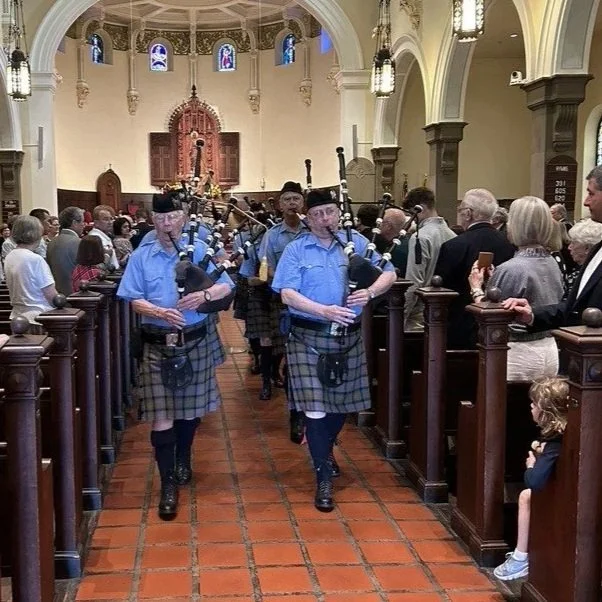
On April 30, 1967, St. Anne’s held its first “Kirkin’ O’ the Tartan.” It has been done every year since then, usually in the second week in June. A bagpipes and drums band, accompanied by banner and flag carriers,, participates in the ‘Kirkin’ (blessing, or literally, “churching”) o’ the Tartans ceremony. Tartans are woven plaid fabrics, with colors and stripes arranged in a distinct pattern to represent a particular Scottish clan. These plaids are used for kilts, sashes, and other articles of clothing. During the service, tartans are brought to the altar for a blessing, and the bagpipe band plays in the church.
The tradition at St. Anne’s was started by The Reverend James Madison, rector from 1957 to 1974. He had Scottish ancestors, was chaplain of the St. Andrews Society, and a member of its board of managers. Maryland Governor and Mrs. Spiro Agnew attended that first service. Following the service, the band also performed at the John Paul Jones crypt at the Naval Academy. Jones, born in Scotland, was a Revolutionary War hero. Security concerns have since ended that part of the Annapolis tradition. The ceremony has been performed nearby at other Episcopal and Presbyterian churches, although none are currently in Anne Arundel County. It has been performed at the National Cathedral in Washington every year since 1952. While the Kirkin’ at St. Anne’s has occurred in June for many years, the most common date for the ceremony is the Sunday nearest November 30, St. Andrew’s Day – St. Andrew being the patron saint of Scotland. Other common dates include “Reformation Sunday” – the Sunday nearest October 31, commemorating the date that Martin Luther nailed his 95 theses to the church door – and on the Sunday nearest April 6, “Tartan Day.” Tartan Day commemorates the date of the Declaration of Arbroath in 1320, a declaration of Scottish independence. In 1987, the celebration of Tartan Day began in Nova Scotia, where many Scots immigrated in the 18th century. President George W. Bush signed a presidential proclamation on April 4, 2008, of a fully official US National Tartan Day observance on April 6 each year.
The inspiration for the ceremony goes back to 17th century Scotland. In 1745, Charles Edward Stuart – the “young pretender” (aka Bonnie Prince Charlie) went to Scotland to raise an army in an effort to take the crown of Scotland and England. As the grandson of the deposed King James II, he did have a claim, but the crown by that time had passed from the House of Stuart to that of Hanover. He enlisted many of the Highland Clans. Although Charlie was Catholic, as was his father and grandfather, most of the Scots who joined him were not. The great majority were Anglicans, and there were also some Scottish Presbyterians. After some early military successes, the rebel army was routed at Culloden. Charlie managed to flee back to France. As part of an effort to break the clan system, Parliament passed several laws, including the Act of Proscription 1746, forbidding the wearing of Highland dress. It did not ban tartan cloth per se, but kilts and other Highland clothing elements. During the years when the English enforced the ban before repealing it in 1782, Highlanders supposedly hid pieces of distinctive tartan under their clothing and brought them to church for a secret blessing (a kirkin’) by the minister at a particular point in the service. How often, if ever, this actually happened is not known.
The Kirkin’ o’ the Tartans ceremony, as we know it was created in 1941 by the Reverend Peter Marshall, a native Scot and pastor of the New York Avenue Presbyterian Church in Washington. During the war, Rev. Marshall held prayer services at New York Avenue to raise funds for British war relief. At one of the services on April 27, 1941, Marshall gave a sermon entitled “the Kirkin’ o’ the Tartans” -and thus the legend was born. As a fundraiser and in order to encourage Scottish-Americans to sign up to fight on behalf of Great Britain, Marshall created the ceremony to instill pride among Scottish-Americans in their homeland.
Eric Fredland, St. Anne’s Historian